
May 29, 2026, 9:56 a.m. ET | ⏱️9–11 minutes
By Ethan Carter
NVIDIA’s dominance of the AI accelerator market has become one of the most remarkable business stories of the past decade.
According to the company’s fiscal 2026 annual report and fiscal 2027 first-quarter earnings release, NVIDIA generated $215.9 billion in revenue during fiscal 2026, representing 65% year-over-year growth. In the first quarter of fiscal 2027, revenue reached $81.6 billion, with the data center segment contributing $75.2 billion, or 92.1% of total revenue. Gross margins have remained near 75% for several years.
CEO Jensen Huang has described the current AI infrastructure buildout as “the largest infrastructure expansion in human history.”
Yet beneath this seemingly unassailable position, the competitive landscape is evolving in ways that market-share charts alone cannot fully capture.
Custom chips developed by hyperscale cloud providers, AMD’s increasingly aggressive roadmap, specialized inference accelerators, and parallel computing ecosystems emerging in response to geopolitical developments are all challenging NVIDIA’s position from different directions.
The central question is no longer who will defeat NVIDIA. Instead, it is which parts of NVIDIA’s dominance may gradually erode—and how the company is adapting to preserve and redefine its leadership.
The Training Stronghold: System-Level Lock-In and Self-Reinforcing Advantages
In large-model training, NVIDIA’s position remains exceptionally strong.
Estimates from industry research firms such as Omdia and Mercury Research suggest that NVIDIA accounted for roughly 90% of AI training accelerator revenue in 2025.
This advantage stems from more than raw chip performance. It is largely rooted in system-level usability at scale.
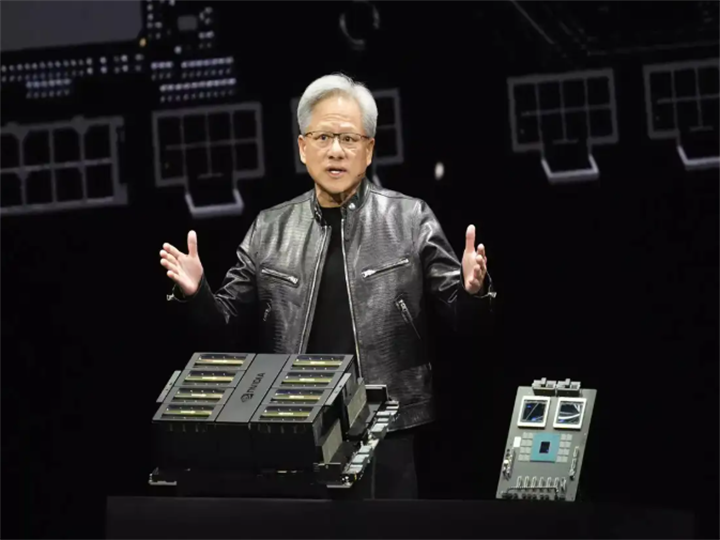
That advantage was further highlighted during NVIDIA’s GTC Taipei keynote on June 1, 2026. Jensen Huang announced that the Vera Rubin platform, designed for the emerging era of AI agents, had entered full-scale production.
According to specifications disclosed during the presentation, Vera Rubin is not simply a GPU platform. It is a complete multi-rack computing system integrating Rubin GPUs (NVL72 with NVLink 72 interconnect), NVIDIA’s custom Vera CPU, ConnectX-9 networking, BlueField-4 security processors, and the company’s latest Spectrum-X Ethernet architecture with co-packaged optics.
NVIDIA stated that a cable-free midplane design reduces rack assembly time from roughly two hours to five minutes, while the associated supply chain is approximately twice the scale of the previous Grace Blackwell generation.
Industry analysis from SemiAnalysis has repeatedly argued that large-scale cluster reliability—often measured through metrics such as mean time between failures and checkpoint recovery overhead—remains one of the most significant barriers for competitors in production environments.
AMD’s MI400 series and Intel’s Falcon Shores architecture continue to improve node-level performance. However, industry observers generally believe that matching NVIDIA’s reliability at massive training scale may still require several years of development.
As a result, NVIDIA’s competitive moat increasingly appears to be system integration rather than any single chip generation.
The Inference Battlefield: Competition Is Emerging from Multiple Directions
Inference has become the area where market dynamics are changing most rapidly.
According to analyst estimates compiled by TrendForce, spending on inference infrastructure surpassed training-related investment for the first time in 2026.
Unlike training workloads, inference must serve millions of diverse requests simultaneously. As a result, infrastructure decisions often prioritize cost efficiency rather than maximum theoretical throughput.
This shift has opened opportunities for several categories of competitors.
Google and the Rise of Purpose-Built AI Infrastructure
One of the most significant developments came from Google Cloud.
On April 22, 2026, Google introduced its eighth-generation Tensor Processing Unit (TPU) family and adopted a strategy not previously seen in its TPU lineup.
Instead of releasing a single general-purpose design, Google split the generation into two products: TPU 8t, optimized for training, and TPU 8i, designed specifically for inference.
According to Google and reporting from TechCrunch, TPU 8t can scale to 9,600 chips within a single Superpod and is intended to reduce cutting-edge model development cycles from months to weeks.
TPU 8i, meanwhile, includes 288 GB of HBM memory and 384 MB of on-chip SRAM. Interconnect bandwidth reportedly reaches 19.2 TB/s, targeting the high-concurrency and low-latency demands expected in AI agent applications.
Some industry analyses cited by TechCrunch suggest that TPU deployments can deliver substantially higher performance-per-dollar than contemporary general-purpose GPUs in certain mixture-of-experts (MoE) inference workloads.
Combined with Google’s JAX and MaxText software stack, this reflects a broader effort to challenge CUDA’s ecosystem lock-in through deep hardware-software integration.
Amazon, Microsoft, and Meta Follow Similar Paths
Google is not alone.
At re:Invent 2024, Amazon Web Services (AWS) stated that its Trainium2 chips could reduce AI workload costs by approximately 30–40% compared with NVIDIA-based alternatives in selected workloads.
Trainium is currently being deployed for AI services supporting partners such as Anthropic.
Meanwhile, Microsoft’s Maia 200 and Meta’s MTIA v3 are handling an increasing share of recommendation, ranking, and content moderation workloads within their respective ecosystems.
Research firm Dell’Oro Group projects that hyperscaler-developed chips could account for approximately 15–20% of global AI inference chip deployments by the end of 2026.
The broader trend is becoming increasingly clear: major cloud providers are no longer acting solely as customers of NVIDIA. They are becoming chip designers in their own right.
Specialized Inference Chips Are Creating New Niches
A second group of challengers focuses on dedicated inference architectures.
Cerebras Systems has attracted attention with its wafer-scale WSE-3 processor, which seeks to eliminate memory bottlenecks common in traditional GPU architectures.
The company has demonstrated strong performance in ultra-fast token generation scenarios and has gained traction in areas such as high-frequency trading and real-time AI agents.
Meanwhile, Groq has pursued a different strategy.
Its Language Processing Unit (LPU) architecture emphasizes deterministic stream processing and has established a niche in ultra-low-latency inference.
One notable industry milestone reportedly occurred in late 2025, when NVIDIA and Groq entered a non-exclusive inference technology licensing arrangement.
While details remain limited, many observers viewed the move as an acknowledgment that specialized inference architectures had become sufficiently mature in certain market segments that collaboration could be more practical than direct competition.
Software Is Quietly Lowering Switching Costs
The third challenge is less visible but potentially significant over the long term: software abstraction.
Frameworks such as PyTorch with torch.compile, together with compiler technologies such as OpenAI Triton, are reducing the friction involved in moving inference workloads away from CUDA-exclusive environments.
Industry analysts covering AI infrastructure have increasingly noted that migration barriers are lower today than they were only a few years ago.
CUDA remains the dominant ecosystem. However, software portability is improving, which may gradually weaken one of NVIDIA’s most durable competitive advantages.
NVIDIA’s Response: From GPU Supplier to AI Infrastructure Company
Faced with growing competition, NVIDIA’s response has been ambitious and highly strategic.
The broader message of the company’s 2026 GTC Taipei keynote was clear: NVIDIA no longer sees itself merely as a GPU company.
Instead, it aims to become the infrastructure platform for the AI agent era.
At the data center level, Vera Rubin reinforces NVIDIA’s system-level advantages.
Perhaps more strategically important was the introduction of the Vera CPU.
According to NVIDIA, the processor uses the Olympus core architecture, can execute up to ten instructions per clock cycle, incorporates 88 cores connected through a unified on-die mesh, and reduces memory latency relative to conventional x86 systems.
The company reported substantial improvements in database and real-time stream-processing workloads.
Whether these gains translate broadly across industries remains to be seen. However, the strategic implication is clear: NVIDIA is expanding competition beyond GPUs and into the entire data center computing stack.
On the consumer side, NVIDIA has partnered with Microsoft and MediaTek to launch RTX Spark, marking a deeper entry into the AI PC market.
The platform is designed to support local AI agents capable of running advanced models directly on devices and interacting with local software without relying entirely on cloud infrastructure.
This initiative suggests that NVIDIA’s long-term ambition extends beyond cloud computing and into billions of endpoint devices.
Geopolitical Fragmentation and the Rise of Parallel Ecosystems
No analysis of the AI chip market is complete without considering geopolitics.
Since 2023, U.S. export controls have increasingly divided the global AI hardware market into partially separate ecosystems.
In regions with limited access to NVIDIA’s most advanced products, local alternatives have gained momentum.
One widely discussed example emerged in April 2026 with the release of DeepSeek V4.
According to reporting from Reuters, the model was designed with native support for Huawei Ascend AI processors and incorporated extensive hardware-software co-optimization.
Many industry observers viewed this as an important milestone. It suggested that training and operating large-scale mixture-of-experts models outside the NVIDIA ecosystem had become technically feasible under certain conditions.
Reuters also reported that the release triggered increased procurement activity among major domestic technology companies seeking to secure local chip supply.
From a global perspective, this market fragmentation produces mixed effects.
On one hand, it reduces NVIDIA’s directly addressable market in certain regions.
On the other hand, it creates barriers that may prevent lower-cost competitors from immediately expanding into Western markets.
The result is a world increasingly characterized by parallel AI computing ecosystems evolving simultaneously, even though the NVIDIA-centered ecosystem continues to dominate overall revenue.
A More Complex Form of Dominance
Taken together, these developments suggest that the AI chip industry in 2026 is moving toward a more nuanced reality than either monopoly or collapse.
In a 2025 report, TrendForce projected that NVIDIA’s share of data center AI accelerator revenue could decline from approximately 83% in 2025 to a range of 70–78% in 2026.
Based on current market trends, that range appears plausible.
However, it is important to recognize that NVIDIA is simultaneously expanding the definition of its addressable market through CPUs, AI PCs, robotics platforms, networking products, and integrated infrastructure systems.
The industry is not experiencing a dramatic regime change. Rather, it appears to be moving toward a more multipolar and competitive structure.
NVIDIA remains the center of gravity in the AI hardware market, but it is no longer the only major object in orbit.
As Jensen Huang stated during his keynote, “Agentic AI has arrived.”
In many ways, the same observation applies to the chip industry itself. There are no permanent rulers—only an ongoing pursuit of greater computing efficiency, better performance per watt, lower costs, and more resilient systems.
References
[1] NVIDIA Fiscal 2026 Annual Report and Fiscal 2027 Q1 Earnings Report
[2] NVIDIA GTC Taipei 2026 Keynote Presentation
[3] Google Cloud TPU Product Announcements (2026)
[4] TrendForce AI Infrastructure Market Research Reports
[5] Reuters coverage of DeepSeek V4 and Huawei Ascend ecosystem developments
About the Author
Ethan Carter focuses on AI chips, semiconductor technology, and computing infrastructure. His work covers GPUs, AI accelerators, edge AI processors, and the hardware systems that power modern artificial intelligence. He writes analytical articles that connect technical developments with industry trends and practical applications.
Preface
The AI chip market in 2026 is increasingly defined by infrastructure strategy rather than individual products. While NVIDIA remains the dominant force in AI acceleration, competitive pressure is emerging from hyperscale cloud providers, specialized inference chip companies, software ecosystems, and geopolitical developments. Understanding these interconnected trends provides a clearer view of where AI infrastructure may be heading over the next several years—and why future competition is likely to be shaped by entire computing ecosystems rather than standalone chips.
Recommend:

When the Brain Connects to Machines: What Brain-Computer Interfaces Can and Can’t Do Right Now

Starship V3’s Global Reverberations:How Low-Cost Access to Orbit Is Redrawing the Space Industry Map

From Pattern Recognition to World Simulation: How the SIMI System Builds “Physical Common Sense” for AI

Why Precision Feeding with Cattle Facial Recognition Is Stalling